When people hear “European networks,” most imagine bureaucrats in Brussels and endless meetings. The reality is different. There are hundreds of people from universities, companies, and nonprofits who are tackling the same questions as we are: how to teach people to work sensibly with artificial intelligence, how to bring it into schools, and how to keep our sanity in the process. This year, we’ve joined several such groups ourselves. Here’s an overview of where we are and why it makes sense to us.
Where We Are
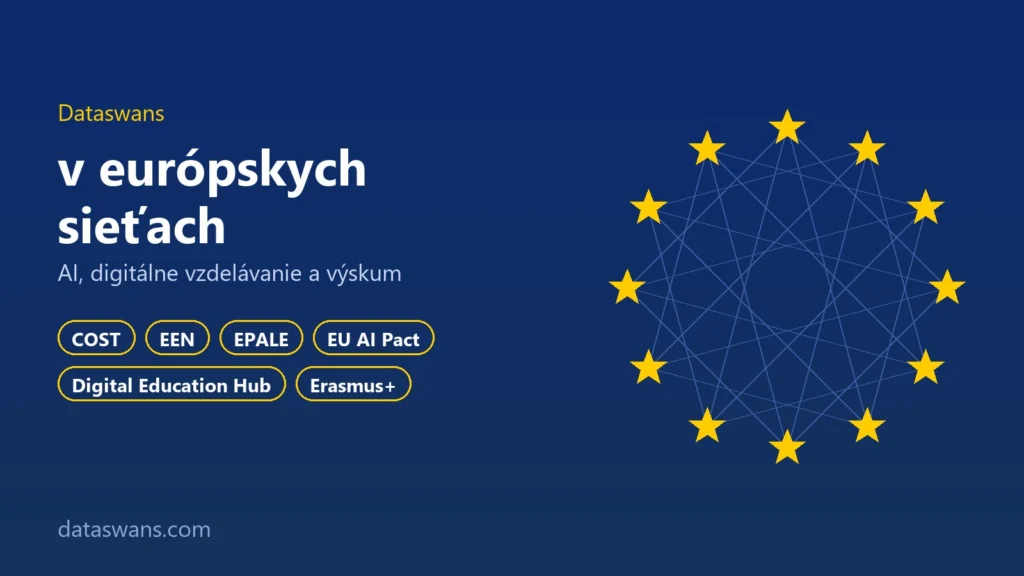
| Network / Group | What it’s about | Our role |
|---|---|---|
| COST Action CA25177 | European research network, 37 countries | Member of Working Groups WG5 and WG8 |
| COST Action CA24167 HUMAN-IT | Digital HR, AI, and HR Analytics | Member of Working Group WG1 |
| Enterprise Europe Network | Business Partnerships in the EU | Published Partner Profile |
| EPALE | Adult Education in Europe | Organization Profile, Partnership Offers |
| European Digital Education Hub | Digital Education and AI Literacy | Community Member as an Expert |
| EU AI Pact | Voluntary Preparation for the AI Act | Signatory to the Commitments |
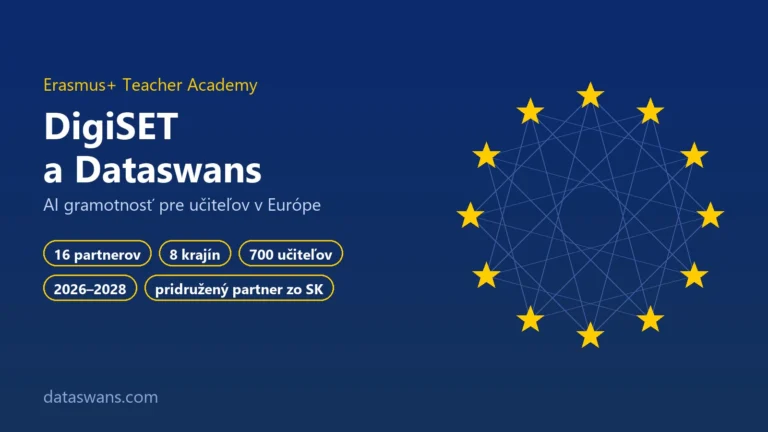
| DigiSET Project | Digital Skills | Associated Partner |
| EU Code Week | Programming and Digital Creativity | Activity Organizer |
COST: When Researchers and Companies Come Together Around One Table
COST (European Cooperation in Science and Technology) is a program that does not fund research itself, but rather people and their collaboration. Each “action” is a four-year network divided into working groups. Anyone who has something to contribute to the topic can apply; the action’s steering committee decides on acceptance.
CA25177: WG5 and WG8
We were accepted into two working groups within Action CA25177. There were over 800 applications; 37 countries are involved, and the action will run until 2030. We brought to WG8 what we do every day: AI literacy modules that we test on real people in real companies. Interestingly, the initiative isn’t just about debates. Its members also want to collaborate on preparing a project proposal for the Horizon Europe program.
HUMAN-IT: How AI Is Changing People’s Work
In the HUMAN-IT initiative, we are part of Working Group 1 (WG1): Digital HRM, AI, and HR Analytics. This group addresses how artificial intelligence is transforming recruitment, employee training, and people management. The group collects literature, prepares professional articles, pilot projects, and webinars. This is particularly valuable to us because we can see how companies in other countries are navigating these changes and compare them to the situation in Slovakia.
Enterprise Europe Network: Finding Partners Without Cold Emails
The Enterprise Europe Network is the European Commission’s network for small and medium-sized enterprises. It works a bit like a matchmaking service: a company publishes a profile (outlining what it offers or is looking for), and contact points in individual countries connect it with interested parties. Our profile, BOSK20261123002, focuses on training in artificial intelligence and process automation. In just a few days, for example, we came across a Greek training company looking for instructors and a Finnish edtech firm interested in expanding into Slovakia.
EPALE: Adult Education
EPALE is a European platform for people who teach adults. We have an organizational profile there and have posted three topics in which we’d like to collaborate on Erasmus+ projects:
- AI literacy and protection against AI and deepfake scams for people over 50,
- generative AI in the workplace for employees of small businesses and public administration,
- AI for instructors: how to teach those who will then teach others.
The first topic is probably the one closest to our hearts. Scams involving fake voices and videos are on the rise, and the generation that didn’t grow up with technology is the one that suffers the most.
European Digital Education Hub
The European Digital Education Hub is a community of nearly 8,000 teachers, researchers, and policymakers. We’ve joined as experts. We’re most interested in the working group that’s addressing how to implement AI literacy in schools in practice. Slovakia hasn’t been very visible there so far, even though we have a lot to show.
EU AI Pact: Commitments We’ve Made to Ourselves
The AI Pact is a voluntary initiative of the European Commission. Through it, companies commit to preparing for the AI Act’s rules before the law requires them to do so. We have signed both pillars and committed to:
- to have an internal policy on AI use and to know exactly which AI systems we’re using,
- to train at least 500 people per year in AI literacy,
- to speak openly about where and how we use AI,
- to share our training materials in the European AI literacy repository.
If we’re teaching others about AI literacy, it’s only fair that we follow the same rules ourselves.
Smaller, but no less meaningful things
Partners from Italy and Austria have welcomed us as associate partners in the DigiSET project, a European Erasmus+ teacher academy focused on digital skills. And as part of EU Code Week, we’re organizing an online workshop where participants will build a simple app using AI, even if they’ve never programmed before.
Why We’re Doing All This
Our vision is for every company, school, and government office in Slovakia to be able to use artificial intelligence safely, responsibly, and to real benefit—not as a trendy gimmick, but as an everyday tool that people understand.
European networks help us in two ways. The first is knowledge: many topics are discussed in Europe before they reach us, and we want to learn about them firsthand. The second is people: partners with whom we can develop a project, compare experiences, or simply ask how they do things in their country.
Our goal for the next two years is simple:
- to become a reliable Slovak partner in European Erasmus+, Horizon Europe, and Digital Europe projects in the field of AI literacy and digital skills,
- to participate in dozens of international projects and bring practical training and pilot testing to Slovakia,
- and to bring what we learn abroad back home to businesses, schools, and public administration.
We join projects as a partner, not as a coordinator. We know best what we do every day: teaching people to work with AI.
Questions we receive
Does COST membership cost anything?
No. COST does not fund companies directly, but it does cover expenses such as travel to meetings, summer schools, or short research stays. The main value lies in the connections and collaboration.
Can a small company join such networks?
Yes. Small companies can also apply to join COST actions, the EEN, and EPALE. All you need is a clear research topic and a willingness to contribute your own work.
How can you contact us about a project?
Through our profile on the Enterprise Europe Network, on the EPALE platform, or simply via our contact information.