AI will answer any question you ask. Quickly, fluently, and with confidence in its voice. That’s exactly the problem: when it doesn’t know, it often won’t say so. Instead, it’ll make up an answer that sounds just as convincing as the real one.
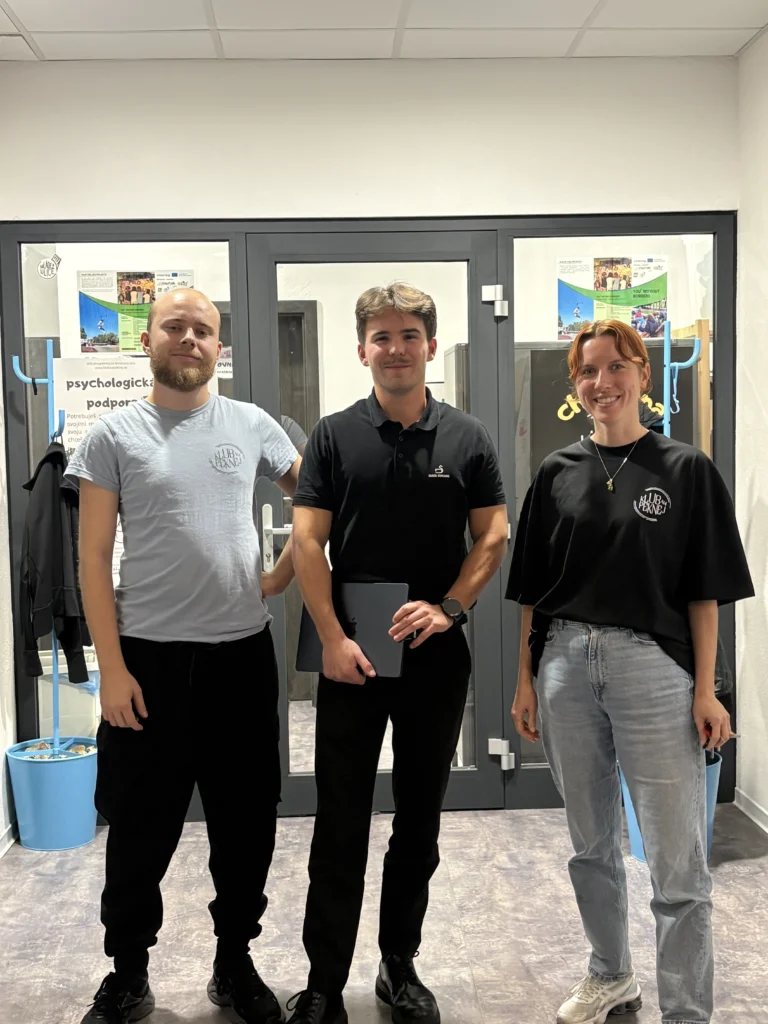
That’s exactly what our talk “AI Makes Things Up with Confidence” was about, which we led with Adam on November 11, 2026, at Klub na Peknej. The main idea can be summed up in three words: confidence doesn’t mean truth. In this article, we summarize what we explained and demonstrated during the lecture so that you can apply it yourself.
How AI Works: Guessing the Next Word
We started with a simple game. We said the beginning of a sentence, such as “The best pizza in Bratislava is…,” and the group finished it. This is exactly how a language model like ChatGPT works. It doesn’t have a database of verified facts. It has learned how words connect and fills in the most likely continuation.
Most of the time, it works well. However, when it doesn’t know the answer—for example, regarding a small local club or an exact number—it will still fill in something. And it sounds just as convincing.
This type of response is called a hallucination: it sounds plausible, but it isn’t true. Even OpenAI, the company behind ChatGPT, admits that hallucinations remain a fundamental problem for all large language models. Its researchers once asked the popular chatbot for the title of one of the study authors’ dissertations. They received three different answers, and not a single one was correct.
Why AI Doesn’t Say “I Don’t Know”
We explained this using a multiple-choice test that everyone is familiar with. If you don’t know the answer and take a guess, you might get lucky. If you leave the box blank, you’re guaranteed a zero. OpenAI researchers show that it’s similar with models: training and evaluation reward guessing more than admitting uncertainty. A model that never says “I don’t know” therefore looks better in the rankings.
During the lecture, we also showed a graph from an OpenAI test: the older model almost always provided an answer and was wrong 75% of the time. The newer model admitted it didn’t know the answer in 52% of cases and was wrong only 26% of the time. The point: “I don’t know” isn’t a weakness, but honesty. This applies to people, too.
Five Forms of Hallucination
- Fictitious facts: numbers, dates, or names that don’t add up.
- Fake sources: studies, books, or links that do not exist. A study in the journal *Scientific Reports* found that 55% of citations in ChatGPT’s academic texts were fabricated using the GPT-3.5 model and 18% using GPT-4.
- Fictitious quotes: words that no one has ever said.
- Falls for a trick: explains something that never happened. For example, why “TikTok was banned in Slovakia in 2019.”
- Outdated information: it used to be true, but it isn’t anymore.
AI most often makes things up when it comes to local topics, exact numbers, recent events, sources, trick questions, and even questions in Slovak. What’s more, it tends to agree with you even when you’re wrong.
Three Cases Where Fabrication Cost Something
Air Canada (2024). The airline’s chatbot told a customer that he could request a discounted ticket for a funeral retroactively. That wasn’t true. The company argued that it wasn’t responsible for the chatbot’s words. It was unsuccessful and had to pay the customer 650 Canadian dollars plus interest and fees.
Deloitte (2025). The consulting firm submitted a report to the Australian government worth 440,000 Australian dollars that contained errors apparently generated by AI, including nonexistent sources. The firm returned the final payment for the contract.
Reports from AI (2025). The European Broadcasting Union and the BBC asked journalists from 22 public media outlets to evaluate over 3,000 responses from ChatGPT, Copilot, Gemini, and Perplexity to questions about the news. As many as 45% of the responses had at least one serious issue, 31% had problems with sources, and 20% contained fundamental inaccuracies, including fabricated details. This is important for young people: according to the Reuters Institute, 7% of people who read the news online use AI assistants for news, but among people under 25, that figure is 15%.
The 3K Rule: Click, Cross-check, When
This is the most important takeaway from the lecture:
- Click. Does the source actually exist and really say what the AI claims? Open the link—don’t just read it. AI can make up links, too.
- Cross-check. Is this confirmed by another, independent source? Another chatbot doesn’t count—it might repeat the same mistake.
- When. Is this up to date? Prices, rules, and even who holds which office change.
Fact-checkers call this “reading between the lines”: instead of examining a single source from the inside, you open additional tabs to find out what others are saying about the claim. Here’s how you can do it:
- searching for an exact phrase in quotation marks,
- Wikipedia as a gateway to sources (not as a final source),
- the Statistical Office of the Slovak Republic and data.slovensko.sk for statistics on Slovakia,
- Demagog.sk and fakty.afp.com for verified claims,
- Google Lens, when you want to find out where an image comes from.
The Detectives Game
We tested the theory right away. The teams were given cards with “AI answers” and had to verify them according to the 3K rule. For example:
- The Great Wall of China is visible from space with the naked eye. (Myth.)
- Goldfish have a memory span of only 3 seconds. (Myth.)
- According to the Statistical Office, Bratislava has one million residents. (False; the 2021 census recorded 475,503 residents.)
- People under 25 use AI for news about twice as often as others. (True.)
The last card is there on purpose. Fact-checking isn’t just about debunking: sometimes you find that a claim is true. That, too, is a good result.
Three sentences to add to your question for the AI
- “If you’re not sure, write ‘I DON’T KNOW.’”
- “Provide a link for every fact that I can open.”
- “What could be wrong with your answer?”
However, the first rule still applies: even links provided by AI need to be opened.
When to Feel Free to Use AI and When to Verify
AI is a good tool for explaining a topic, summarizing text, generating ideas, or suggesting a structure. Always verify the facts, numbers, quotes, and sources that will go into your work, presentations, or social media posts. You—not the AI—are responsible for what you submit.
If you’re working with AI and data, continue reading the article AI and Data: How to Safely Use Artificial Intelligence in Analysis. You can verify numbers from news reports or chatbots by following the instructions in How to Verify Statistics in 3 Minutes. And if AI generates a graph for you, run it through the checklist 7 Questions to Ask Every Chart. Also be careful about what you feed into the AI: Other people’s personal data doesn’t belong in a chatbot—read more in the article Data Ethics.
Thank you to Klub na Peknej for hosting us. If you’d like a similar talk at your club, school, or organization, contact us via the project website www.dataswans.com/projekt.
Sources
- OpenAI: Why language models hallucinate (September 2025)
- Kalai, Nachum, Vempala, Zhang: Why Language Models Hallucinate (arXiv, 2025)
- Advanced Television: Study: AI misrepresents news content 45% of the time (EBU and BBC, October 2025)
- Walters, W. H. and Wilder, E. I. (2023): Fabrication and errors in the bibliographic citations generated by ChatGPT. Scientific Reports 13, 14045
- Yahoo News: Air Canada Must Pay Refund After Chatbot Gave Wrong Information
- CTV News (AP): Deloitte to partially refund Australian government for report with apparent AI-generated errors
The Data for Change project is funded by the European Union under the European Solidarity Corps program. The views and opinions expressed are those of the authors and do not necessarily reflect the views of the European Union or the National Agency (NIVAM). Neither the European Union nor the National Agency assumes responsibility for them.